

TIRF Perspectives: AI as a Co-Writer, Not a Ghostwriter
Editor’s note: “TIRF Perspectives” is a new publications activity from TIRF. It profiles recent research and developments in English Language Teaching (ELT) in a practical and accessible format. TIRF Perspectives is aimed at parents, teachers, school leaders, and all student advocates who want to review recent educational trends regarding AI in a non-academic way. This piece is authored by Dr. Parisa Mehran (HAN University of Applied Sciences, the Netherlands).

As I sit down to write this piece, I find myself caught between two very loud crowds. On one side, AI is celebrated as a writing miracle. On the other, it is condemned as a writing apocalypse. Depending on whom you ask, AI is either the greatest educational innovation of our time or an existential threat to writing, thinking, and even our jobs. AI will either make writing magically easy or mechanically empty. Either students do the writing, or AI does it for them. This all-or-nothing rhetoric leaves little room for the reality of writing with, not by, AI. As a multilingual English language teacher, I stand somewhere between the middle of the tech-hype and tech-lash, where I see the good, the bot, and the ugly.
Where We Are
On the Pain of Writing
When I was a PhD student, I felt so seen by PhD Comics whenever they joked about the pain of writing. I thought if writing is painful even for those writing in their first language, maybe writing is simply hard. Then I realized that for multilingual ELLs, writing carries another layer of pain: getting ideas through the gate of academic English.
For years, multilingual ELLs, especially in higher education, were judged, and even humiliated, by their writing. They were taught to write like machines: polished, structured, flawless. Then machines learned to write like them. Suddenly, we viewed the very polish we had demanded as a red flag. Now, we miss the mistakes we once put down. AI detectors made this worse, often discriminating against multilingual ELLs. Students now leave in errors, cut em dashes, and avoid “it’s not just X, it’s Y” just to prove their writing is theirs. This is the cost of AI shaming, and the hidden privilege behind it: forgetting that writing has never been equally accessible to all, and that it has long served as a gatekeeper for multilingual ELLs.
AI Can Be More Than a Shortcut
Imagine having a brilliant idea but struggling to express it because language, attention, memory, or processing get in the way. Many multilingual and neurodivergent ELLs know this feeling well. This is why a curated use of AI can improve academic writing for ELLs. In this sense, AI can be more than a shortcut. By reducing “unnecessary” cognitive load, it can create space for creativity and help learners’ voices be heard. What we are witnessing is the collapse of a long-standing monopoly on good expression that excluded too many voices for too long, not the death of writing.
Where We’re Going
Finding the “Write Balance”
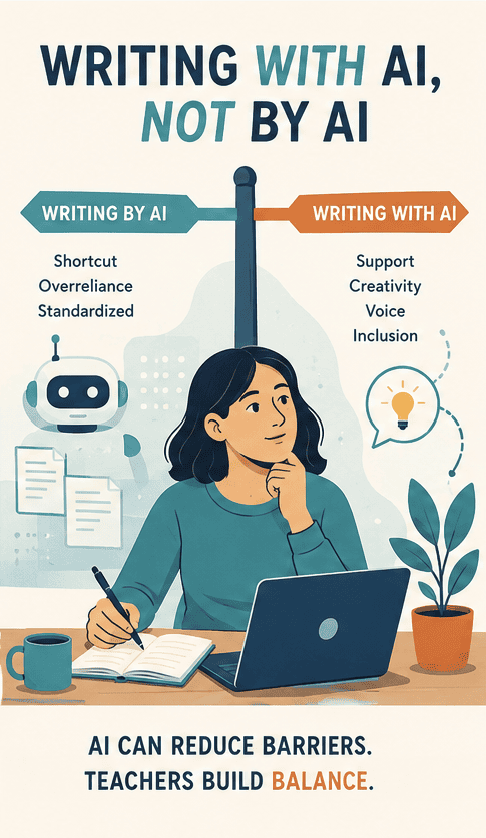
There is a difference between writing with AI and writing by AI. The first can reduce language barriers, boost confidence, and enhance creativity. The second risks bypassing thinking, standardizing writing, and creating overreliance. Much of the current debate treats these practices as identical. AI can support linguistic equity and create space for inclusive practices such as translanguaging, where ELLs can bring in their full linguistic repertoire, for example, to brainstorm, clarify ideas, compare expressions across languages, and then shape their writing in English. But this does not happen automatically. Teachers play a crucial role in helping students use AI as a co-writer, not a ghostwriter. Let’s not forget that our students have digital rights: They deserve guidance in using AI critically, ethically, and responsibly. If this is our goal, we then need to shift the debate toward the “write balance.”
A Call for Hamdardi
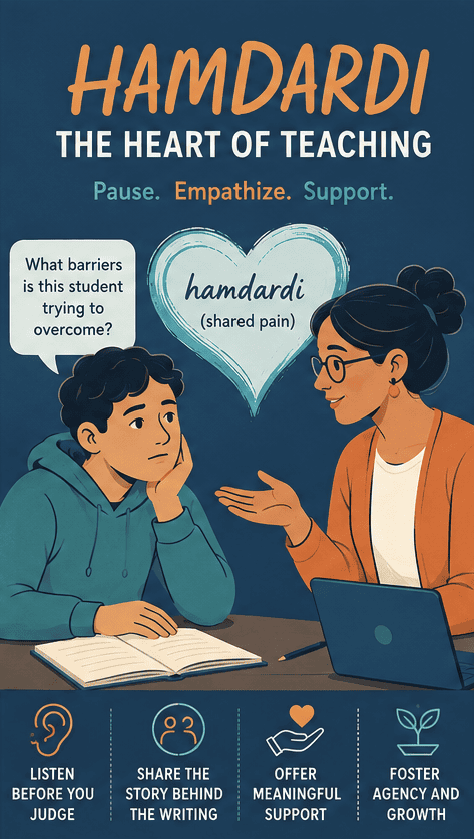
Writing is difficult. No wonder it has become one of the most common uses of AI. But the pain of writing is not equally shared. The next time we notice AI in a student’s writing, maybe our first response should be to pause and practice hamdardi, a Persian word that literally means “shared pain.” Rooted in empathy, hamdardi asks us to recognize and share the pain of the other before rushing to judge. What if the issue is not laziness? What barriers is this student trying to overcome? What kind of support can I offer to help this student write with more agency?

Over to You
These questions matter because the future of writing is hybrid – humans and AI will increasingly write together – and our students need to learn to co-exist with AI. But this coexistence cannot be left to technology alone. That is why we, teachers, are needed more than ever, to “keep humans in the loop!”
Teachers remain central to the writing process, not as gatekeepers, but as guides who help students navigate the productive struggle that writing has always required. When teachers and ELLs work together through the struggles of drafting, revising, and thinking, writing remains a deeply human act—one grounded not only in words, but also in empathy, growth, and hamdardi.
Join the conversation on Substack – click here! How are you deploying AI ethically and productively in your English teaching?
Additional Resources
For teachers who are curious about using AI more critically, ethically, and responsibly, several helpful resources are worth exploring, including TESOL’s AI Guidelines for the ELT Professional, the British Council’s AI Guidelines for Teachers, the MLA-CCCC Joint Task Force on Writing and AI, and NCTE’s ELA AI Framework Cohorts.
Bio

Parisa Mehran is a futurist dedicated to exploring and designing technologies that can better shape the future of education. She holds a PhD in Computer-Assisted Language Learning and is a lecturer in English and Intercultural Business Communication. She serves as an AI in Education Advisor at the International School of Business, HAN University of Applied Sciences, in the Netherlands.